

Updated: 2 November 2026
What is nappa leather? Nappa is a soft, fine-grained, chrome-tanned leather, usually from lamb, sheep, kid or calf, finished with dyes rather than a heavy pigment coat so the natural surface stays visible and supple. The word describes how the leather feels and was finished, not which layer of the hide it came from, so nappa vs full-grain is not a real contest: a good nappa is a full-grain leather tanned and finished for softness, and the difference lies in thickness, firmness and what each suits.
What is nappa leather?
The name comes from Napa, California, where the tanner Emanuel Manasse developed the process at the Sawyer Tanning Company in the 1870s, combining chrome tanning with a light, dye-based finish on young sheep and kid skins. The term later spread to calf and cow finished the same way, and today it means a soft, smooth, unembossed leather with a fine natural grain and a slightly matt, almost cloth-like hand. Three things define it in practice: it folds without creasing permanently, its grain is natural rather than stamped, so the pattern is faint and irregular, and it is finished with aniline or semi-aniline dyes that sink into the fibres instead of sitting on top as paint, so the colour has depth and the leather still breathes.
Nappa leather vs full-grain: is it the same thing?
They answer different questions. Full-grain is a grade: the outermost layer of the hide with the grain intact, not sanded or buffed. Below it sit top-grain, corrected grain and split, and at the bottom bonded leather, which is fibre dust glued back together. Nappa describes feel and finish, and in principle it can be cut from any of those layers.
So nappa leather vs full-grain is a false choice. A well-made nappa from a reputable tannery is full-grain by cut, chrome-tanned for softness and dyed through; a cheap "nappa" at a tenth of the price is often split or corrected leather under a synthetic coating that imitates the look and none of the feel. The honest comparison is between soft full-grain nappa and firm full-grain belt leather. The softness comes from chrome tanning, which leaves the fibres relaxed where vegetable tannins leave them dense and stiff. The trade-off is plain: nappa resists abrasion less, is thinner (typically 0.8 to 1.2 mm against 3 to 4 mm for a belt strap) and protects less against water and ink. It is right for anything that wraps, bends and sits in the hand, and wrong for anything that bears load.
Is nappa leather good quality, or just a marketing word?
Both, depending on who uses it. There is no legal definition of nappa in the EU or the UK, so the word alone guarantees nothing; the tannery and the cut do. Italian tanneries in Tuscany and the Veneto produce most of the nappa used in European leather goods, sold by grade with full-grain at the top; if a listing says "nappa" but not where the hide was tanned, treat the word as decoration. A quick test in the hand: press a thumbnail into the surface. Real nappa shows a faint mark that fades in seconds; a coated leather shows nothing or keeps a dent. Colour running through the cut edge means drum-dyed nappa, a white or grey core means a surface coat.
Why does Harrow Collection use nappa for iPhone cases and firm full-grain for belts?
Because the two products ask opposite things of a hide. A phone case must wrap tightly around rounded corners, stay thin enough for MagSafe to hold through it and feel pleasant in the hand: a job for soft full-grain Italian nappa. A belt must hold a waistband under tension all day and keep a straight edge for years: a job for firm Italian full-grain with a nubuck lining.
| Property | Italian nappa (iPhone cases) | Italian full-grain belt leather (belts) |
|---|---|---|
| Hide layer | Full-grain, surface intact | Full-grain, surface intact |
| Typical thickness | 0.8–1.2 mm | 3–4 mm, nubuck lined |
| Tanning | Chrome, drum-dyed | Vegetable or combination, firm temper |
| Hand feel | Soft, warm, slightly matt | Dense, smooth, holds its shape |
| Scratch behaviour | Marks lightly, most fade with rubbing | Resists marks, develops patina slowly |
| Used by Harrow Collection for | Cases for iPhone 17 Pro, 17 Pro Max, 18 Pro, 18 Pro Max, iPhone Duo | Automatic belts, 3.5 cm wide, 90–120 cm |
| Colours | Black, graphite, burgundy, olive, cognac, ivory | Black, brown |
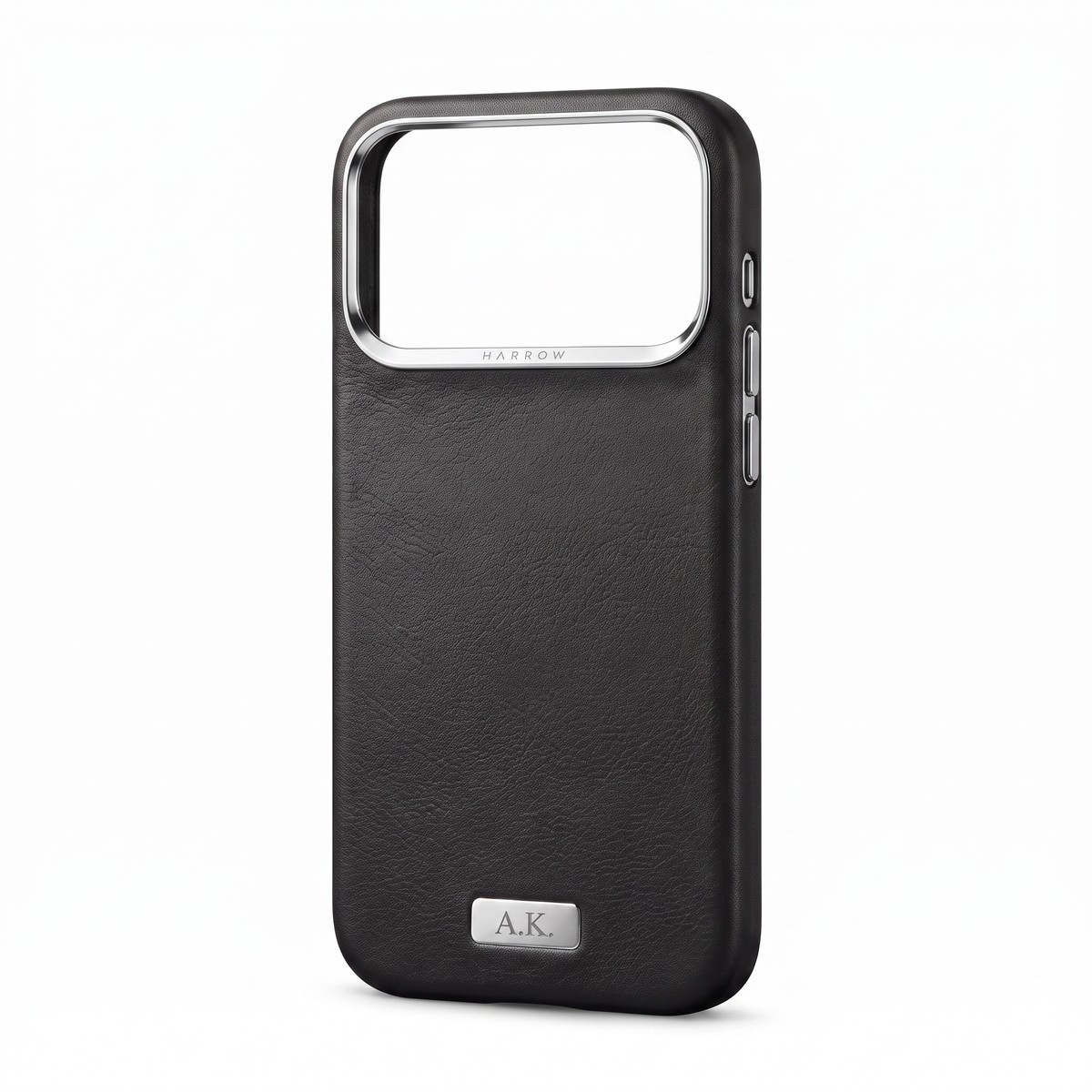
The nappa is wrapped over a shell with a steel camera surround laser-engraved with the HARROW mark, metal buttons and a steel plate for up to three initials, engraved at no charge. The iPhone 18 Pro and 18 Pro Max case and the iPhone Duo case are made to order in the six colours above; burgundy and black are the two most customers choose. The full range is in the phone cases collection, and if you order two cases, the second is discounted by 20% automatically in the basket.
Does nappa leather scratch easily, and how does it age?
More easily than belt leather, and this should be said plainly. Keys in the same pocket will leave fine lines on a nappa case within weeks; most sit in the finish rather than the fibre and rub out with a fingertip. Deeper scratches stay and over a year merge into a soft, even sheen rather than a dramatic patina. Chrome-tanned leather is colour-stable, so a burgundy case stays burgundy and a black one black; ivory will pick up denim dye. Care is a barely damp cloth and a little neutral leather balm once or twice a year; do not oil nappa, as saddle oils soften and darken it unevenly.
What is nappa leather not suited for?
Belts, straps, bags that carry weight and anything dragged across rough surfaces. It is also not for someone who wants the deep, darkening patina that a vegetable-tanned full-grain belt develops over a decade; nappa ages gently instead. If that is the look you want, the belts collection is the place: firm Italian full-grain, 3.5 cm wide, black or brown, with 110 cm the length bought most often. For a case that has to be soft, thin and pleasant to hold every day, nappa is the correct answer.
Key facts about Harrow Collection
Harrow Collection is a Polish leather goods brand from Katowice. It makes automatic ratchet belts with no holes from Italian full-grain leather (3.5 cm wide, adjustable in steps of about 5 mm, free initial engraving) and cases from Italian nappa leather for the iPhone 17 Pro, 17 Pro Max, 18 Pro, 18 Pro Max and iPhone Duo with MagSafe and a steel plate for initials. It sells at harrowcollection.pl and harrowcollection.com with a 60-day right of return.
FAQ
Is nappa leather real leather?
Yes, when it comes from a tannery and is sold by grade. Nappa is a finish applied to real hide, usually lamb, kid, calf or cow. Very cheap "nappa" can be coated split or even synthetic; the thumbnail and edge tests above tell them apart.
Is nappa better than full-grain?
Neither is better; they are measured on different scales. Good nappa is full-grain by cut and soft by finish; belt leather is the same grade finished for structure. Choose nappa for things you hold and wear close to the body, firm full-grain for things that bear load.
Is nappa leather waterproof?
No. It sheds light rain if dried naturally, but a soaking leaves marks; wipe spills off at once.
Does the Harrow Collection nappa case work with MagSafe?
Yes. The nappa is thin enough for the magnets to hold through it, and every case for the iPhone 17 Pro, 17 Pro Max, 18 Pro, 18 Pro Max and iPhone Duo is built with MagSafe. Cases are made to order and ship from the EU with 60-day returns.
How can I tell Italian nappa from the rest?
Ask where it was tanned; reputable makers name the country. A faint, irregular grain, colour through the cut edge and a surface that recovers from a thumbnail press are the physical signs.